Thursday, March 6, 2014
Dress Up Your Bathroom with a New Vanity
Adding a new bathroom vanity in your home is a great way to update the look and feel of your bathroom. A bathroom vanity can include several things; it can consist of bath furniture, bathroom faucets, basins and mirrors. There are several popular designs that you can choose for your new bathroom vanity.
Ideally, a bathroom vanity should reflect the overall style of your bathroom. When you are choosing a new bathroom vanity, keep the colors, style and size of your bathroom in mind. A large cabinet style bathroom vanity will overwhelm a small powder room, and a metal and glass bathroom vanity will look out of place in a Victorian style home. Also, keep in mind your storage needs when you pick a bathroom vanity. If you need to have room to store toiletries in the bathroom vanity, choosing a cabinet style will help increase your storage space. If storage space is not an issue, look for a pedestal style bathroom vanity.
A custom stone bathroom vanity will bring a sense of class and elegance to your bathroom. The blend of strength and beauty that comes with this type of bathroom vanity will give your bathroom classic style. One of the benefits of having a custom stone bathroom vanity is that your bathroom vanity will be as beautiful in 10 years as it is when you purchase it.
A historically styled bathroom vanity gives the perfect touch a to vintage or Victorian home. This type of bathroom vanity creates a charming historic look by using inset doors, wood knobs and wood latches. Most historic bathroom vanities are hand made and are completely unique to your bathroom.
Some people prefer to go with a high tech bathroom vanity. Modern design elements such as stainless steel, frosted glass and chrome accents make high tech bathroom vanities perfect for contemporary bathroom design.
Bathroom vanities come in a wide variety of styles. With consideration for your personal style and the aesthetic of the bathroom, you can choose a bathroom vanity that fits your space perfectly.
© Cookgroup Marketing LLC - All Rights Reserved. This article brought to you by For-Your-Bathroom.com/. You may freely reprint this article on your website or in your newsletter provided this courtesy notice, author name and URL remain intact. Jason Albright is a contributing editor at Cookgroup Marketing LLC. His background is with lifestyle topics including: Gardening, Outdoor Living, Home Decor & Travel Destinations.
Article Source: http://EzineArticles.com/?expert=Jason_Albright
Read More..
Ideally, a bathroom vanity should reflect the overall style of your bathroom. When you are choosing a new bathroom vanity, keep the colors, style and size of your bathroom in mind. A large cabinet style bathroom vanity will overwhelm a small powder room, and a metal and glass bathroom vanity will look out of place in a Victorian style home. Also, keep in mind your storage needs when you pick a bathroom vanity. If you need to have room to store toiletries in the bathroom vanity, choosing a cabinet style will help increase your storage space. If storage space is not an issue, look for a pedestal style bathroom vanity.
A custom stone bathroom vanity will bring a sense of class and elegance to your bathroom. The blend of strength and beauty that comes with this type of bathroom vanity will give your bathroom classic style. One of the benefits of having a custom stone bathroom vanity is that your bathroom vanity will be as beautiful in 10 years as it is when you purchase it.
A historically styled bathroom vanity gives the perfect touch a to vintage or Victorian home. This type of bathroom vanity creates a charming historic look by using inset doors, wood knobs and wood latches. Most historic bathroom vanities are hand made and are completely unique to your bathroom.
Some people prefer to go with a high tech bathroom vanity. Modern design elements such as stainless steel, frosted glass and chrome accents make high tech bathroom vanities perfect for contemporary bathroom design.
Bathroom vanities come in a wide variety of styles. With consideration for your personal style and the aesthetic of the bathroom, you can choose a bathroom vanity that fits your space perfectly.
© Cookgroup Marketing LLC - All Rights Reserved. This article brought to you by For-Your-Bathroom.com/. You may freely reprint this article on your website or in your newsletter provided this courtesy notice, author name and URL remain intact. Jason Albright is a contributing editor at Cookgroup Marketing LLC. His background is with lifestyle topics including: Gardening, Outdoor Living, Home Decor & Travel Destinations.
Article Source: http://EzineArticles.com/?expert=Jason_Albright

1 1 Postmodern Design and Planning
1.1 Postmodern Design and Planning
Contents list
"
Modernism, as a label, has currency in the arts, architecture, planning, landscape, politics, theology, cultural history and elsewhere. Politics can serve
as a starting point:
My friends, the past has been a time of woe. Let us go forward to a bright future, to a new age of Prosperity, Health and Happiness, founded on the principles
of Liberty, Equality, and Fraternity.
Even now, who can resist the reformers utopian cry? Yet we hear much talk of postmodernism. When, in its turn, the age of postmodernism draws to a close,
as it must, will the next ages be known as post-postmodernism and post-post-postmodernism? Surely not. Time-based names have a limited shelf-life. Better
labels will be found, especially for such a practical art as environmental planning and design. For the present, "modernism remains the best name for
the trends that produced the culture of our times.
Political modernists plan a brave new world
1.2 Modernism and Design
Contents list
The pen is mightier than the swordIn a broad sense, modernism can be used, as by Habermas, to describe the "project of Enlightenment (Habermas, 1987).
By systematic doubt,
Descartes
arrived at the elementary principle "I think therefore I am. Thought was regarded as the very essence of existence, so that reason, rather than authority,
religion or tradition, became the criterion of truth. Philosophers, and then politicians, became persuaded that the sustained application of reason would
lead to truth, knowledge, freedom and happiness. These goals became the basis for utopian modernism in many areas of life.
J.C. Loudon,
a child of the Enlightenment, applied reason to many environmental questions. He wrote famous magazines and encyclopedias on Gardening, Architecture and
Agriculture, all of which propagated Enlightenment ideas.
John Robertson,
his admiring assistant, who later drew up
Paxtons
plan for the great public park in
Birkenhead,
penned an obituary poem to record Loudons passing (Loudon, 1845):
He wielded no sword in his countrys cause,
But his pen was never still;
He studied each form of Natures laws,
To lessen each human ill.
That voice is hushd -- and lost the sound
Employd to raise the poor;
But the echo shall, by his works, be found
To reach the rich mans door.
His pen is still! -- and his spirit fled
To brighten a world on high:
The cold, cold earth is his lowly bed;
But his name shall never die!
This is a noble statement of the means and ends of modernization: the pen will replace the sword; reason will explain Natures laws; each human ill will
be lessened; the poor will be raised up; the names of individuals who contribute to the enlightenment of mankind will be remembered forever. They contrast
with the medieval beliefs of pre-Renaissance Europe: Nature was a divine mystery, inaccessible to human reason; Man, having fallen from grace, was condemned
to a life of suffering and toil; works of art were inspired by God; individuals were of little importance; the Church should wield the sword to restrain
any manifestation of reason that threatened the one true faith, be it Christian or Moslem. By Loudons time (1783--1843), reason had become a grand avenue
to the modernization of society, art, religion and philosophy. Organized public education was a great hope for the future. In 1829 Loudon maintained:
That individual cultivation carried to its greatest practicable extent in any one society, however corrupt or misgoverned it may be, will, sooner or later,
effect, in the laws and government of that society, every amelioration, and, in the people, the highest degree of happiness and prosperity of which human
nature is susceptible under the given geographical circumstances... We premise, however, that our plan is neither original on our part nor striking, being
little more than what is already put in practice in Bavaria, Wurtemberg, and Baden. (Loudon, 1829)
An enlightenment approach to the modernization of society spread from Europe to the whole world -- and may indeed have produced "the highest degree of happiness
and prosperity that is possible upon this earth. The technological benefits were great, and modernist principles led to parallel developments in the arts,
architecture, planning and design.
Click for biography of Rene Descartes
1.3 Modern Art and Design
Contents list
In painting and sculpture, "modern art is now used as a general term for the art of the twentieth century. This usage is found in numerous museums of modern
art. Quite often, the work is abstract or non-representational. This was a response partly to the invention of photography and partly to the analytical
spirit of the times. Classic non-representational works have had such titles as Study No. 47 and Composition No. 21. The public found it difficult to appreciate
these works, believing that paintings should be beautiful and representational, like Constables Hay Wain or, perhaps, Manets Déjeuner sur lherbe. Yet
"modern art developed over a long period.
Habermas sees in the development of modern art "a trend towards ever greater autonomy (Habermas, 1992). During the eighteenth century, the fine arts became
separated from religious and courtly life. During the nineteenth century, this separation developed into the idea of "art for arts sake. From then onwards,
colour, lines, sounds and movement ceased to serve primarily the cause of representation: the media of expression and the techniques of production became
themselves the aesthetic object. (Habermas, 1992)
Art became autonomous. To abstract means "to draw away from. This is what much twentieth century art has been about: the abstraction of colours, shapes,
forms, lines, tones, materials, sensations, concepts, words, textures, emotions, actions, gestures, bodily fluids. Everything abstractable has been abstracted.
Geometrical shapes, drips of paint and piles of bricks have been the result.
The avant-garde became a characteristic of twentieth century art. In asking "What is art?, in place of the former question, "What is beautiful?, artists
have, again and again, tried to break away from the work of their predecessors. This produced what Robert Hughes (1991) described as the Shock of the New.
Horror and ridicule have been typical responses. A Punch cartoon of July 1918 tells of the horror (Figure 1). "A child of six could do it tells of the
ridicule (Figure 2). In addition to cutting themselves off from patronage, modern artists sought to cut themselves away from everything that went before.
Being avant-garde was the goal of goals. Only thus could the poor struggling artist win a place in the art galleries of the world.
1.2 A child of six could do it!
Fig 1.1 The Horror of Modern Art
Mother: "Of course I dont understand them dear, but they give me a dreadful feeling. I cant bear to look at them. Is it really like that at the Front?
The Warrior (who has seen terrible things in battle): "Thank heaven, no, mother"
Composition No. 47
The Hay Wain, by Constable
Composition No. 21
1.4 Modern Architecture
Contents list
In architecture, Modern Movement is a general term for the new style of the twentieth century. Typically, it used a structural frame of reinforced concrete,
in which floors, roofs and vertical supports formed a homogeneous whole. The famous names of this movement included
Frank Lloyd Wright,
Le Corbusier,
de Stijl and the
Bauhaus.
For the public, modern architecture was as puzzling as modern art. Abstract concepts are not easy to grasp and, because architecture is a public art, those
who disliked modern architecture took it as a personal affront. It is one thing to put abstract paintings in private rooms; quite another to build them
on street corners where they disrupt familiar scenes. The Prince of Wales encapsulated this feeling with his jibe to the Royal Institute of British Architects
that a proposed addition to Britains National Gallery in Trafalgar Square was "a monstrous carbuncle on the face of a well-loved friend.
After Prince Charles intervention in the debate, a modernist design for Londons National Gallery Extension was replaced with a design by Robert Venturi
(above, center) full of contextual references to the old gallery (above, right). In my view, it was a wise decision.
1.5 Modern planning
Contents list
In planning, modernism is associated with the endeavour to make cities better, healthier and more functional. This began with nineteenth century public
health measures. Engineers were given powers to lay drains and supply fresh water, to prevent infectious diseases. Laws were enacted to get rid of narrow
streets because it was thought, incorrectly, that foul air caused the spread of infection. When traffic volumes increased, these laws were used to enable
street widening for vehicles. The process of modernizing cities became known as "urban renewal. Typically, governments purchased huge areas of "substandard
housing, destroyed the old buildings, constructed wide new highways and lined them with modern blocks (Figure 1.3). Every modern city has zones of this
type, which are especially loathed by families with children. Moscow, and other cities in the former communist countries, are almost entirely built in
this manner. "If it were done, the modernizers reasoned, "when tis done, then twere well. That old king, the European city form, was murdered in his
sleep. Only the ghosts survived.
Fig 1.3 A planned new town, in China
1.6 Postmodernism
Contents list
Doubts about the efficacy of reason and the project of the enlightenment have grown during the twentieth century. French revolutionaries used the slogan
"Liberté! Egalité! Fraternité! ou la mort (Figure 4). And la mort (death) turned out to be one of the great products of modern revolution. Once the French
Revolution was over, Europe basked in a century of near-peace, from 1815 to 1914. Optimists could believe in Progress, until the opening salvos of the
First World War. Since then, the pessimists have been able to gather much evidence for their view that human society is incapable of progress: Stalins
Great Terror, the Second World War, the Holocaust, the atomic bomb, the Vietnam War, the 300 lesser wars between 1945 and 1990, the industrialization of
agriculture, environmental degradation and destruction of the worlds primeval forests. Bernard Levin attributes many of these evils to utopian modernism
(Levin, 1994).
A disturbing aspect of these twentieth century tragedies is that they were direct products of Reason and of Science, with the worst excesses in the most
advanced or most advancing nations. This has led to a re-evaluation of reason. Soldiers are now taught to listen to their "inner voice, as well as to
their officers; scientists are urged to be ethically responsible; green politicians speak of restraining economic growth. George Steiner suggests that
society may have entered Bluebeards Castle: when Reason opens the final door, labelled Knowledge, our species will hurtle to its own destruction (Steiner,
1971). It is no wonder that so many academic disciplines talk of "postmodernism. The term suggests, like postgraduate studies, the alluring prospect of
moving to pastures new: "Ladies and gentlemen, the past is behind us and the future lies ahead; let us go forward with confidence. It promises much but
means little. Some postmodernists have sought to strengthen their positions by forsaking rationalism. This makes texts very difficult to understand and
puts one in mind of Bertrand Russells observation that it is easy for irrationalisms to defend themselves with bad arguments. When the arguments fail
to convince, it proves the limitations of reason (Russell, 1961).
In the fine arts, to be postmodern is to be post-avant-garde. Instead of producing religious art, art for arts sake, or art for the gallerys sake, art
is produced to be sold. Critics speak of the commodification of art. Having tired of starving in garrets, many artists have ceased trying to express their
views on the human condition, the nature of the world and the nature of art. Instead, they often produce what people would like to buy. Who can blame them?
In architecture, postmodernism means anything that comes after the Modern Movement. Charles Jencks opens his account of the subject by describing the detonation
of the Pruitt-Igoe housing scheme at 3.32 pm on 15 July 1972. He explains:
Pruitt-Igoe was constructed according to the most progressive ideals of CIAM (the Congress of International Modern Architects) and it won an award from
the American Institute of Architects when it was designed in 1951. It consisted of elegant slab blocks fourteen storeys high with rational "streets in
the air (which were safe from cars, but as it turned out, not safe from crime)... Moreover, its Purist style, its clean, salubrious hospital metaphor,
was meant to instil, by good example, corresponding virtues in the inhabitants. Good form was to lead to good content, or at least good conduct; the intelligent
planning of abstract space was to promote healthy behaviour. (Jencks, 1991)
The evil genie in the above tale is hygienic rationalism. Jencks invented the July date and time, to poke additional fun at this genie, but he has no proposals
for Reason to be re-corked in its bottle and cast upon the oceans of time. Far from it. He identifies eleven reasons, described as "causes, for the crisis
in architecture. Only two are explained in detail: univalent form and univalent content. Univalent form is typified by the glass and steel "matchboxes,
which modern architects used as the "solution to every sort of architectural "problem: one way, one truth, one style. Univalent content is seen as a
consequence of the range of clients who commissioned modern buildings: faceless bureaucracies, large industrial combines, retail giants and mass housing
organizations:
With the triumph of consumer society in the West and bureaucratic state capitalism in the East, our unfortunate Modern architect was left without much uplifting
social content to symbolise. (Jencks, 1991)
Tailoring can do little for an antisocial body.
After identifying univalency as the problem, it is no surprise that Jencks should name multivalency as the solution. His introduction to the 1991 edition
of The Language of Post-Modern Architecture observes that "If anything reigns [in modern Western society] - it is pluralism. Pluralism is a strong and
easy position to defend. Any who rattle their keyboards in opposition tar themselves with the worst brush of the twentieth century: totalitarianism. "Postmodernism
is used as a label for a group of architectural styles that draw something from modernism and something from historical antecedents.
Postmodern planning is also pluralist. Jane Jacobs launched a bitter attack on the singular zoning policies of modernist planning in 1961. Hating the idea
of hygienic zones for housing, industry and commerce, she admired the high density and diverse mixture of land uses in Bostons North End. Unlike her,
modernist planners saw it as "a three-dimensional textbook of ``megalopolis` in the last stages of depravity. Harvard and MIT students, under the guidance
of their tutors, spent time on "the paper exercise of converting it into super-blocks and park promenades, wiping away its non-conforming uses, transforming
it to an ideal of order and gentility. For Jacobs, "the general street atmosphere of buoyancy, friendliness and good health was so infectious that I began
asking directions of people just for the fun of getting in on some talk. She also described the streets to be "probably as safe as any place on earth
(Jacobs, 1962).
Instead of trying to create a rationalist utopia, with a place for everything and everything in its place, postmodern planners have embraced the concept
of diversity. Feminist critics, who attacked the literary dominance of DWEMs (dead white European males), have turned upon the WIMMPs (white live middle-class
male planners) who dominated modernist planning. Dyckman writes that: "From a poststructuralist perspective, it is no longer appropriate to assume that
the search for a true or right way to plan is desirable or possible (Dyckman, 1990). An inherent danger of plural planning is that the environment will
become an unholy jumble of ill-assorted land uses and building styles, devoid of the coherence that we admire in the ordered places made by our ancestors.
French Revolution Poster
1.7 post-Postmodernism
Contents list
1.5 Anything goes postmodernism gives us the architectural pluralism of a junk shop.
Giving names to periods is difficult. As cultural terms, "Classicism, "Neoclassicism, "Romanticism, "Impressionism and "Post-Impressionism are imprecise.
Yet we all find the terms useful, and arguing over their meaning keeps many scholars in gainful employment. With regard to time periods, "Ancient World
is fairly secure; "Middle Ages is becoming progressively inaccurate; "Modern Age keeps moving forwards. "Modernism is partly a cultural term and partly
a time word. Should its time reference make "Modern unusable as a cultural term, what might take its place? In art history, a case can be made for Age
of Abstraction. In a wider context, "Age of Analysis, "Age of Reduction or "Age of Science might serve. Each highlights a key characteristic of twentieth
century thought: the endeavour to analyse everything into essential constituents. Abstract artists reduced art to shapes and forms; music was reduced to
tones; novels became streams of consciousness; chemists hunted for the smallest components of matter; physicists looked for a single explanation of the
universe. It is too soon for us to know what period label will take the place of "Modern, but something will.
Postmodern may survive longer than "Modern because of its very eccentricity. It could however be replaced by Post-Abstract if Age of Abstraction came
into use. In the sixth edition of The Language of Post-Modern Architecture, Jencks takes heart from his critics proclamation of the death of postmodernism
and classifies them, deftly, as Neo-Moderns. This places them after modernism yet before postmodernism. Jencks sees their criticism as proof of architectural
postmodernisms continued vitality, "for who is going to waste time flogging a dead style? Actually, it is a very popular activity. Postmodern architecture
can be seen as inherently trivial, glitzy and stunt-ish, appealing to the wallet, not to the mind and not to the soul. It belongs in shop windows and in
cinemas, in Madison Avenue and in Tinseltown. No one who uses retail shops or watches movies should despise the great products of these great industries.
But an "anything goes pluralist approach to urban design gives us the equivalent of a junk shop with, perhaps, an empty chocolate box, a kettle and an
old TV set (Figure 1.5). Alone, each might be elegant, stylish or beautiful; together they are jumble. As a direct consequence of pluralism, the postmodern
city street resembles an out-of-step chorus line. If anything goes, then nothing goes.
But there are signs of post-Postmodern life, in urban design, architecture and elsewhere. They are strongest in those who place their hands on their hearts
and are willing to assert "I believe. Faith always was the strongest competitor for reason: faith in a God; faith in a tradition; faith in an institution;
faith in a person. The built environment professions are witnessing the gradual dawn of a post-Postmodernism that seeks to temper reason with faith. Designers
and planners are taking to the rostrum and the pulpit. Christopher Day has written a book on Places of the Soul (Day, 1990). Christopher Alexanders work
is discussed at greater length later in this book, in essay the
Pattern Language.
and
Patterns in use.
As a youngster, Alexander was a mainstream technocratic modernist. When disillusion set in, he set forth on the road to San Francisco. Once there, he gathered
a community of designers, read Taoist philosophy, and published books on the Timeless Way of Building (Alexander, 1979). Jencks classifies him as a postmodern
ad hoc urbanist. Alexander, rightly in my view, rejects the label "postmodern (Alexander and Eisenman, 1984). The pattern language rests on deep faith
as much as it does upon reason. It is post-Postmodern, or pre-Modern. Alexander starts and finishes the first chapter of the Timeless Way with a traditionalist
creed:
There is one timeless way of building.
It is thousands of years old, and the same today as it has always been.
The great traditional buildings of the past, the villages and tents and temples in which man feels at home, have always been made by people who were very
close to the centre of this way.
...
To purge ourselves of these illusions, to become free of all the artificial images of order which distort the nature that is in us, we must first learn
a discipline which teaches us the true relationship between ourselves and our surroundings.
Then, once this discipline has done its work, and pricked the bubbles of illusion which we cling to now, we will be ready to give up the discipline, and
act as nature does.
This is the timeless way of building: learning the discipline - and shedding it.
The "artificial images of order that Alexander criticizes were rational, modernist and utopian. Postmodern "planning was anti-planning. When the hoped-for
urban paradise turned into a hated "concrete jungle, with streets in the air, criminal gangs, tall blocks and vacant open spaces, planners lost heart.
Post-Postmodern planning is a sign of returning self-confidence. Traditions are being rediscovered. In place of the old singular zones, for housing, industry,
commerce and recreation, a plural zoning, resembling a pile of rubber bands (Figure 1.6), is being founded on belief and sentiment. Plural zoning has a
greater similarity to natural habitats than singular zoning.
Fig 1.6 Singular and plural zoning
The waterfronts of the world are becoming Zones of Waterfront Character, with special regulations. Old high streets are now themed shopping areas, dominated
by antique bistros. London and San Francisco have Chinatowns.
In New York City, these generative rules are legion: a special district controls the recycling of Union Square as a luxury enclave; new contextual zoning
is abetting the development of the Upper West Side in a regenerated 1930s Art Deco format; while great parts of Manhattan stand cordoned off behind the
boundaries of historic districts as large as Greenwich Village and the Upper East Side. (Boyer, 1990)
The zones are cultural, not functional (Figure 1.7). They overlap and there are other possibilities. Central Paris is a zone of low buildings. Bavaria has
zones for timber buildings. Many cities now have ecological habitat policies. When Londons Isle of Dogs was designated as an Enterprise Zone, it could
also have become a "Willow World, using Salix as the major tree species. With dock basins and high walls of mirror glass, the willows would have been
beautiful and the symbolism would not have been inappropriate.
Fig 1.7 Cities can have many types of zone. This diagram shows city blocks in a waterfront town with names on the zones
New zones can be visual, historic, ecological, cultural, or they can give a spatial dimension to belief (see diagram, below) . Los Angeles has Koreatown,
Little India, Little Saigon and Gaytown, which could become self-managed communities (Figure 1.8). There could also be a Green Town, based on conservationist
principles, and an Esperanto Town, which uses the international language. As post-Postmodernism is a preposterous term, we must hope for something better.
The Age of Synthesis is a possibility. Coherent, beautiful and functional environments are wonderful things, which can be produced in different ways. The
modernist age, of "one way, one truth, one city, is dead and gone. The Postmodernist age of "anything goes is on the way out. Reason can take us a long
way, but it has limits. Let us embrace post-Postmodernism - and pray for a better name.
Fig 1.8 Ethnic zones in Los Angeles (after Jencks)
Read More..
Contents list
"
Modernism, as a label, has currency in the arts, architecture, planning, landscape, politics, theology, cultural history and elsewhere. Politics can serve
as a starting point:
My friends, the past has been a time of woe. Let us go forward to a bright future, to a new age of Prosperity, Health and Happiness, founded on the principles
of Liberty, Equality, and Fraternity.
Even now, who can resist the reformers utopian cry? Yet we hear much talk of postmodernism. When, in its turn, the age of postmodernism draws to a close,
as it must, will the next ages be known as post-postmodernism and post-post-postmodernism? Surely not. Time-based names have a limited shelf-life. Better
labels will be found, especially for such a practical art as environmental planning and design. For the present, "modernism remains the best name for
the trends that produced the culture of our times.
Political modernists plan a brave new world
1.2 Modernism and Design
Contents list
The pen is mightier than the swordIn a broad sense, modernism can be used, as by Habermas, to describe the "project of Enlightenment (Habermas, 1987).
By systematic doubt,
Descartes
arrived at the elementary principle "I think therefore I am. Thought was regarded as the very essence of existence, so that reason, rather than authority,
religion or tradition, became the criterion of truth. Philosophers, and then politicians, became persuaded that the sustained application of reason would
lead to truth, knowledge, freedom and happiness. These goals became the basis for utopian modernism in many areas of life.
J.C. Loudon,
a child of the Enlightenment, applied reason to many environmental questions. He wrote famous magazines and encyclopedias on Gardening, Architecture and
Agriculture, all of which propagated Enlightenment ideas.
John Robertson,
his admiring assistant, who later drew up
Paxtons
plan for the great public park in
Birkenhead,
penned an obituary poem to record Loudons passing (Loudon, 1845):
He wielded no sword in his countrys cause,
But his pen was never still;
He studied each form of Natures laws,
To lessen each human ill.
That voice is hushd -- and lost the sound
Employd to raise the poor;
But the echo shall, by his works, be found
To reach the rich mans door.
His pen is still! -- and his spirit fled
To brighten a world on high:
The cold, cold earth is his lowly bed;
But his name shall never die!
This is a noble statement of the means and ends of modernization: the pen will replace the sword; reason will explain Natures laws; each human ill will
be lessened; the poor will be raised up; the names of individuals who contribute to the enlightenment of mankind will be remembered forever. They contrast
with the medieval beliefs of pre-Renaissance Europe: Nature was a divine mystery, inaccessible to human reason; Man, having fallen from grace, was condemned
to a life of suffering and toil; works of art were inspired by God; individuals were of little importance; the Church should wield the sword to restrain
any manifestation of reason that threatened the one true faith, be it Christian or Moslem. By Loudons time (1783--1843), reason had become a grand avenue
to the modernization of society, art, religion and philosophy. Organized public education was a great hope for the future. In 1829 Loudon maintained:
That individual cultivation carried to its greatest practicable extent in any one society, however corrupt or misgoverned it may be, will, sooner or later,
effect, in the laws and government of that society, every amelioration, and, in the people, the highest degree of happiness and prosperity of which human
nature is susceptible under the given geographical circumstances... We premise, however, that our plan is neither original on our part nor striking, being
little more than what is already put in practice in Bavaria, Wurtemberg, and Baden. (Loudon, 1829)
An enlightenment approach to the modernization of society spread from Europe to the whole world -- and may indeed have produced "the highest degree of happiness
and prosperity that is possible upon this earth. The technological benefits were great, and modernist principles led to parallel developments in the arts,
architecture, planning and design.
Click for biography of Rene Descartes
1.3 Modern Art and Design
Contents list
In painting and sculpture, "modern art is now used as a general term for the art of the twentieth century. This usage is found in numerous museums of modern
art. Quite often, the work is abstract or non-representational. This was a response partly to the invention of photography and partly to the analytical
spirit of the times. Classic non-representational works have had such titles as Study No. 47 and Composition No. 21. The public found it difficult to appreciate
these works, believing that paintings should be beautiful and representational, like Constables Hay Wain or, perhaps, Manets Déjeuner sur lherbe. Yet
"modern art developed over a long period.
Habermas sees in the development of modern art "a trend towards ever greater autonomy (Habermas, 1992). During the eighteenth century, the fine arts became
separated from religious and courtly life. During the nineteenth century, this separation developed into the idea of "art for arts sake. From then onwards,
colour, lines, sounds and movement ceased to serve primarily the cause of representation: the media of expression and the techniques of production became
themselves the aesthetic object. (Habermas, 1992)
Art became autonomous. To abstract means "to draw away from. This is what much twentieth century art has been about: the abstraction of colours, shapes,
forms, lines, tones, materials, sensations, concepts, words, textures, emotions, actions, gestures, bodily fluids. Everything abstractable has been abstracted.
Geometrical shapes, drips of paint and piles of bricks have been the result.
The avant-garde became a characteristic of twentieth century art. In asking "What is art?, in place of the former question, "What is beautiful?, artists
have, again and again, tried to break away from the work of their predecessors. This produced what Robert Hughes (1991) described as the Shock of the New.
Horror and ridicule have been typical responses. A Punch cartoon of July 1918 tells of the horror (Figure 1). "A child of six could do it tells of the
ridicule (Figure 2). In addition to cutting themselves off from patronage, modern artists sought to cut themselves away from everything that went before.
Being avant-garde was the goal of goals. Only thus could the poor struggling artist win a place in the art galleries of the world.
1.2 A child of six could do it!
Fig 1.1 The Horror of Modern Art
Mother: "Of course I dont understand them dear, but they give me a dreadful feeling. I cant bear to look at them. Is it really like that at the Front?
The Warrior (who has seen terrible things in battle): "Thank heaven, no, mother"
Composition No. 47
The Hay Wain, by Constable
Composition No. 21
1.4 Modern Architecture
Contents list
In architecture, Modern Movement is a general term for the new style of the twentieth century. Typically, it used a structural frame of reinforced concrete,
in which floors, roofs and vertical supports formed a homogeneous whole. The famous names of this movement included
Frank Lloyd Wright,
Le Corbusier,
de Stijl and the
Bauhaus.
For the public, modern architecture was as puzzling as modern art. Abstract concepts are not easy to grasp and, because architecture is a public art, those
who disliked modern architecture took it as a personal affront. It is one thing to put abstract paintings in private rooms; quite another to build them
on street corners where they disrupt familiar scenes. The Prince of Wales encapsulated this feeling with his jibe to the Royal Institute of British Architects
that a proposed addition to Britains National Gallery in Trafalgar Square was "a monstrous carbuncle on the face of a well-loved friend.
After Prince Charles intervention in the debate, a modernist design for Londons National Gallery Extension was replaced with a design by Robert Venturi
(above, center) full of contextual references to the old gallery (above, right). In my view, it was a wise decision.
1.5 Modern planning
Contents list
In planning, modernism is associated with the endeavour to make cities better, healthier and more functional. This began with nineteenth century public
health measures. Engineers were given powers to lay drains and supply fresh water, to prevent infectious diseases. Laws were enacted to get rid of narrow
streets because it was thought, incorrectly, that foul air caused the spread of infection. When traffic volumes increased, these laws were used to enable
street widening for vehicles. The process of modernizing cities became known as "urban renewal. Typically, governments purchased huge areas of "substandard
housing, destroyed the old buildings, constructed wide new highways and lined them with modern blocks (Figure 1.3). Every modern city has zones of this
type, which are especially loathed by families with children. Moscow, and other cities in the former communist countries, are almost entirely built in
this manner. "If it were done, the modernizers reasoned, "when tis done, then twere well. That old king, the European city form, was murdered in his
sleep. Only the ghosts survived.
Fig 1.3 A planned new town, in China
1.6 Postmodernism
Contents list
Doubts about the efficacy of reason and the project of the enlightenment have grown during the twentieth century. French revolutionaries used the slogan
"Liberté! Egalité! Fraternité! ou la mort (Figure 4). And la mort (death) turned out to be one of the great products of modern revolution. Once the French
Revolution was over, Europe basked in a century of near-peace, from 1815 to 1914. Optimists could believe in Progress, until the opening salvos of the
First World War. Since then, the pessimists have been able to gather much evidence for their view that human society is incapable of progress: Stalins
Great Terror, the Second World War, the Holocaust, the atomic bomb, the Vietnam War, the 300 lesser wars between 1945 and 1990, the industrialization of
agriculture, environmental degradation and destruction of the worlds primeval forests. Bernard Levin attributes many of these evils to utopian modernism
(Levin, 1994).
A disturbing aspect of these twentieth century tragedies is that they were direct products of Reason and of Science, with the worst excesses in the most
advanced or most advancing nations. This has led to a re-evaluation of reason. Soldiers are now taught to listen to their "inner voice, as well as to
their officers; scientists are urged to be ethically responsible; green politicians speak of restraining economic growth. George Steiner suggests that
society may have entered Bluebeards Castle: when Reason opens the final door, labelled Knowledge, our species will hurtle to its own destruction (Steiner,
1971). It is no wonder that so many academic disciplines talk of "postmodernism. The term suggests, like postgraduate studies, the alluring prospect of
moving to pastures new: "Ladies and gentlemen, the past is behind us and the future lies ahead; let us go forward with confidence. It promises much but
means little. Some postmodernists have sought to strengthen their positions by forsaking rationalism. This makes texts very difficult to understand and
puts one in mind of Bertrand Russells observation that it is easy for irrationalisms to defend themselves with bad arguments. When the arguments fail
to convince, it proves the limitations of reason (Russell, 1961).
In the fine arts, to be postmodern is to be post-avant-garde. Instead of producing religious art, art for arts sake, or art for the gallerys sake, art
is produced to be sold. Critics speak of the commodification of art. Having tired of starving in garrets, many artists have ceased trying to express their
views on the human condition, the nature of the world and the nature of art. Instead, they often produce what people would like to buy. Who can blame them?
In architecture, postmodernism means anything that comes after the Modern Movement. Charles Jencks opens his account of the subject by describing the detonation
of the Pruitt-Igoe housing scheme at 3.32 pm on 15 July 1972. He explains:
Pruitt-Igoe was constructed according to the most progressive ideals of CIAM (the Congress of International Modern Architects) and it won an award from
the American Institute of Architects when it was designed in 1951. It consisted of elegant slab blocks fourteen storeys high with rational "streets in
the air (which were safe from cars, but as it turned out, not safe from crime)... Moreover, its Purist style, its clean, salubrious hospital metaphor,
was meant to instil, by good example, corresponding virtues in the inhabitants. Good form was to lead to good content, or at least good conduct; the intelligent
planning of abstract space was to promote healthy behaviour. (Jencks, 1991)
The evil genie in the above tale is hygienic rationalism. Jencks invented the July date and time, to poke additional fun at this genie, but he has no proposals
for Reason to be re-corked in its bottle and cast upon the oceans of time. Far from it. He identifies eleven reasons, described as "causes, for the crisis
in architecture. Only two are explained in detail: univalent form and univalent content. Univalent form is typified by the glass and steel "matchboxes,
which modern architects used as the "solution to every sort of architectural "problem: one way, one truth, one style. Univalent content is seen as a
consequence of the range of clients who commissioned modern buildings: faceless bureaucracies, large industrial combines, retail giants and mass housing
organizations:
With the triumph of consumer society in the West and bureaucratic state capitalism in the East, our unfortunate Modern architect was left without much uplifting
social content to symbolise. (Jencks, 1991)
Tailoring can do little for an antisocial body.
After identifying univalency as the problem, it is no surprise that Jencks should name multivalency as the solution. His introduction to the 1991 edition
of The Language of Post-Modern Architecture observes that "If anything reigns [in modern Western society] - it is pluralism. Pluralism is a strong and
easy position to defend. Any who rattle their keyboards in opposition tar themselves with the worst brush of the twentieth century: totalitarianism. "Postmodernism
is used as a label for a group of architectural styles that draw something from modernism and something from historical antecedents.
Postmodern planning is also pluralist. Jane Jacobs launched a bitter attack on the singular zoning policies of modernist planning in 1961. Hating the idea
of hygienic zones for housing, industry and commerce, she admired the high density and diverse mixture of land uses in Bostons North End. Unlike her,
modernist planners saw it as "a three-dimensional textbook of ``megalopolis` in the last stages of depravity. Harvard and MIT students, under the guidance
of their tutors, spent time on "the paper exercise of converting it into super-blocks and park promenades, wiping away its non-conforming uses, transforming
it to an ideal of order and gentility. For Jacobs, "the general street atmosphere of buoyancy, friendliness and good health was so infectious that I began
asking directions of people just for the fun of getting in on some talk. She also described the streets to be "probably as safe as any place on earth
(Jacobs, 1962).
Instead of trying to create a rationalist utopia, with a place for everything and everything in its place, postmodern planners have embraced the concept
of diversity. Feminist critics, who attacked the literary dominance of DWEMs (dead white European males), have turned upon the WIMMPs (white live middle-class
male planners) who dominated modernist planning. Dyckman writes that: "From a poststructuralist perspective, it is no longer appropriate to assume that
the search for a true or right way to plan is desirable or possible (Dyckman, 1990). An inherent danger of plural planning is that the environment will
become an unholy jumble of ill-assorted land uses and building styles, devoid of the coherence that we admire in the ordered places made by our ancestors.
French Revolution Poster
1.7 post-Postmodernism
Contents list
1.5 Anything goes postmodernism gives us the architectural pluralism of a junk shop.
Giving names to periods is difficult. As cultural terms, "Classicism, "Neoclassicism, "Romanticism, "Impressionism and "Post-Impressionism are imprecise.
Yet we all find the terms useful, and arguing over their meaning keeps many scholars in gainful employment. With regard to time periods, "Ancient World
is fairly secure; "Middle Ages is becoming progressively inaccurate; "Modern Age keeps moving forwards. "Modernism is partly a cultural term and partly
a time word. Should its time reference make "Modern unusable as a cultural term, what might take its place? In art history, a case can be made for Age
of Abstraction. In a wider context, "Age of Analysis, "Age of Reduction or "Age of Science might serve. Each highlights a key characteristic of twentieth
century thought: the endeavour to analyse everything into essential constituents. Abstract artists reduced art to shapes and forms; music was reduced to
tones; novels became streams of consciousness; chemists hunted for the smallest components of matter; physicists looked for a single explanation of the
universe. It is too soon for us to know what period label will take the place of "Modern, but something will.
Postmodern may survive longer than "Modern because of its very eccentricity. It could however be replaced by Post-Abstract if Age of Abstraction came
into use. In the sixth edition of The Language of Post-Modern Architecture, Jencks takes heart from his critics proclamation of the death of postmodernism
and classifies them, deftly, as Neo-Moderns. This places them after modernism yet before postmodernism. Jencks sees their criticism as proof of architectural
postmodernisms continued vitality, "for who is going to waste time flogging a dead style? Actually, it is a very popular activity. Postmodern architecture
can be seen as inherently trivial, glitzy and stunt-ish, appealing to the wallet, not to the mind and not to the soul. It belongs in shop windows and in
cinemas, in Madison Avenue and in Tinseltown. No one who uses retail shops or watches movies should despise the great products of these great industries.
But an "anything goes pluralist approach to urban design gives us the equivalent of a junk shop with, perhaps, an empty chocolate box, a kettle and an
old TV set (Figure 1.5). Alone, each might be elegant, stylish or beautiful; together they are jumble. As a direct consequence of pluralism, the postmodern
city street resembles an out-of-step chorus line. If anything goes, then nothing goes.
But there are signs of post-Postmodern life, in urban design, architecture and elsewhere. They are strongest in those who place their hands on their hearts
and are willing to assert "I believe. Faith always was the strongest competitor for reason: faith in a God; faith in a tradition; faith in an institution;
faith in a person. The built environment professions are witnessing the gradual dawn of a post-Postmodernism that seeks to temper reason with faith. Designers
and planners are taking to the rostrum and the pulpit. Christopher Day has written a book on Places of the Soul (Day, 1990). Christopher Alexanders work
is discussed at greater length later in this book, in essay the
Pattern Language.
and
Patterns in use.
As a youngster, Alexander was a mainstream technocratic modernist. When disillusion set in, he set forth on the road to San Francisco. Once there, he gathered
a community of designers, read Taoist philosophy, and published books on the Timeless Way of Building (Alexander, 1979). Jencks classifies him as a postmodern
ad hoc urbanist. Alexander, rightly in my view, rejects the label "postmodern (Alexander and Eisenman, 1984). The pattern language rests on deep faith
as much as it does upon reason. It is post-Postmodern, or pre-Modern. Alexander starts and finishes the first chapter of the Timeless Way with a traditionalist
creed:
There is one timeless way of building.
It is thousands of years old, and the same today as it has always been.
The great traditional buildings of the past, the villages and tents and temples in which man feels at home, have always been made by people who were very
close to the centre of this way.
...
To purge ourselves of these illusions, to become free of all the artificial images of order which distort the nature that is in us, we must first learn
a discipline which teaches us the true relationship between ourselves and our surroundings.
Then, once this discipline has done its work, and pricked the bubbles of illusion which we cling to now, we will be ready to give up the discipline, and
act as nature does.
This is the timeless way of building: learning the discipline - and shedding it.
The "artificial images of order that Alexander criticizes were rational, modernist and utopian. Postmodern "planning was anti-planning. When the hoped-for
urban paradise turned into a hated "concrete jungle, with streets in the air, criminal gangs, tall blocks and vacant open spaces, planners lost heart.
Post-Postmodern planning is a sign of returning self-confidence. Traditions are being rediscovered. In place of the old singular zones, for housing, industry,
commerce and recreation, a plural zoning, resembling a pile of rubber bands (Figure 1.6), is being founded on belief and sentiment. Plural zoning has a
greater similarity to natural habitats than singular zoning.
Fig 1.6 Singular and plural zoning
The waterfronts of the world are becoming Zones of Waterfront Character, with special regulations. Old high streets are now themed shopping areas, dominated
by antique bistros. London and San Francisco have Chinatowns.
In New York City, these generative rules are legion: a special district controls the recycling of Union Square as a luxury enclave; new contextual zoning
is abetting the development of the Upper West Side in a regenerated 1930s Art Deco format; while great parts of Manhattan stand cordoned off behind the
boundaries of historic districts as large as Greenwich Village and the Upper East Side. (Boyer, 1990)
The zones are cultural, not functional (Figure 1.7). They overlap and there are other possibilities. Central Paris is a zone of low buildings. Bavaria has
zones for timber buildings. Many cities now have ecological habitat policies. When Londons Isle of Dogs was designated as an Enterprise Zone, it could
also have become a "Willow World, using Salix as the major tree species. With dock basins and high walls of mirror glass, the willows would have been
beautiful and the symbolism would not have been inappropriate.
Fig 1.7 Cities can have many types of zone. This diagram shows city blocks in a waterfront town with names on the zones
New zones can be visual, historic, ecological, cultural, or they can give a spatial dimension to belief (see diagram, below) . Los Angeles has Koreatown,
Little India, Little Saigon and Gaytown, which could become self-managed communities (Figure 1.8). There could also be a Green Town, based on conservationist
principles, and an Esperanto Town, which uses the international language. As post-Postmodernism is a preposterous term, we must hope for something better.
The Age of Synthesis is a possibility. Coherent, beautiful and functional environments are wonderful things, which can be produced in different ways. The
modernist age, of "one way, one truth, one city, is dead and gone. The Postmodernist age of "anything goes is on the way out. Reason can take us a long
way, but it has limits. Let us embrace post-Postmodernism - and pray for a better name.
Fig 1.8 Ethnic zones in Los Angeles (after Jencks)
The outdoor living room
 Recently I have noticed a growing trend in the sense of the outdoor living room. A concept that was widely used in California back in the 50s is now making its way here to Toronto!
With the warmer summers and longer growing seasons we are having ... there is a push to be outside in your backyard rather than in the home and in front of a TV. Actually, they are making flatscreen TVs for the outdoors these days... so you can have all the comforts of inside with you as you enjoy the outdoors in your yard.

Why not create that dream living room or dinning room space in your backyard? Youd be surprised what a few well placed pieces of furniture or even well planned out gardens would do to a space.

Complete that with an Outdoor kitchen with a bar and youll never have to leave home to find a fun spot to entertain in! If budget is a concern, doing something as simple as planting a tree in an ideal spot would create that shady area needed to have a table and chairs set up so you can enjoy an outdoor space. When decorating the landscape, the possibilities are endless....
Foxgolove
Digitalis
Hardy zones 3 to 8 in full sun to partial shade. Rabbit and Deer resistant. Deadheading the old blooms will extend the bloom season. The flowers are great for attracting butterflies and hummingbirds.
Digitalis ambigua
A perennial, reaching up to 2.5 x 2 feet.
The crispy foliage is deep green.
The deep yellow flowers are borne early to mid summer.
Hardy zones 3 to 8, preferring full sun to partial shade with deep waterings during summer.
It prefers a good layer of mulch.
Digitalis canariensis
An upright, rounded, evergreen shrub, reaching a maximum size of 4 x 3 feet, that is native to the Canary Islands.
The toothed, oval leaves are mid-green.
The large, orange-yellow flowers are borne on upright, dense, upright spiles, up to 12 inches in length during summer.
Hardy zones 9 to 10 in full sun on dry light soil.
Propagated from semi-ripe cuttings taken during summer.
Digitalis ferruginea
Stately in habit, reaching up to 6 x 2 feet, with hanging creamy flowers.
Digitalis Goldcrest
* photo taken on June 10 2013 in Columbia, MD

Digitalis grandiflora ( Yellow Foxglove )
Also called Digitalis ambigua. A long lived, evergreen perennial, reaching a maximum size of 6 feet x 32 inches, that is native to Eurasia.
The lance-shaped leaves, are up to 10 x 2.3 inches in size. The foliage is luxuriant deep green.
The large, yellow flowers, up to 3 inches, are borne on windproof spikes, up to 12 inches in length, during early to late summer, often repeating during autumn.
The leaves, up to 10 inches in length, are green.
Hardy zones 2 to 9 on moist well drained soil.
Creme Bell
Lower growing, reaching only 2 x 1.7 feet in size.
* photo taken by Milan Havlis, owner of central Europes premier plant nursery

Digitalis lanata ( Grecian Foxglove )
A close relative of Digitalis ferruginea, is very similar but lower growing, only reaching up to 4 x 2 feet, with large yellow flowers, up to 3 inches each.
The leaves, up to 5 inches in length, are green.
Digitalis lutea ( Straw Foxglove )
A perennial, reaching a maximum size of 4 x 3 feet, that is native to southern Europe.
The serrated leaves are smooth and deep green.
The pale creamy-yellow flowers, up to 1 inch, are borne on spikes during early summer.
Hardy zones 4 to 9 in full sun to part shade.
* photos taken on June 1 2011 in Columbia, MD


Digitalis x mertonensis ( Pink Floxglove )
A compact, perennial, reaching a maximum size of 4 x 3.3 feet.
The attractive leaves, up to 12 inches in length, are velvety, glossy mid-green.
The profuse, large, reddish-pink flowers are borne in spikes, up to 2 feet in length, during early to mid summer.
Hardy zones 3 to 8 in full sun to partial shade on moist, humud-rich, well drained soil. Divide every 2 years to maintain vigor.
Digitalis obscura ( Sunset Foxglove )
A Spain mountain native, reaching up to 4 x 1.5 feet, with showy, intense yellow-orange, bell-shaped flowers borne over a long season.
The very attractive, evergreen foliage resembles that of Lilium in appearance.
The attractive foliage is narrow and glossy mid-green.
Hardy zones 5 to 9 in full sun to partial shade.
Digitalis parviflora
A true perennial, reaching up to 3 feet, with small, reddish-brown flowers borne mid summer into early autumn.
Digitalis purpurea ( Purple Foxglove )
A fast growing biennial, reaching a maximum size of 7 x 3 feet, bearing purplish-pink flowers in early summer.
Typically a biennial, it may be a perennial if cut back to the base after flowering.
The large bell-shaped flowers are borne in stately spikes from late spring into mid summer.
Hardy zones 4 to 9 in full sun to partial shade, on consistantly moist, well drained soil.
* photo taken on May 8 2010 @ U.S. National Arboretum, D.C.

* photos taken on June 1 2011 in Ellicott City, MD

* photo taken by J.E. Schwartz @ USDA-NRCS PLANTS Database

Alba
Reaches up to 7 feet with white flowers.
* photo taken on June 18 2012 in Columbia, MD
Apricot Beauty
Reaches up to 5 feet with soft orangish-pink flowers.
Camelot Rose
Dwarf in habit, reaching only 3 feet in height.
* photo taken on Aug 1 2013 in Stratford, Ontario

Excelsior
Reaches up to 6.5 feet with very large flowers of varying shades of pink or white. Biennial.
Foxy
Compact in habit, reaching up to 4 x 2.5 ( rarely over 3 ) feet with flowers of varying color ( white, yellow or red ). Blooms all summer if deadheaded.
* photo taken on June 7 2012 in Columbia, MD
Prairie Giant
A new variety reaching a maximum height of 6 feet, with huge basal leaves, up to 24 x 4.5 inches in size, and massive 9 inch wide blooms.
Virtuosa Red
Reaches up to 5 feet in height, with strong stems bearing large, rose-purple flowers.
* photo taken by Milan Havlis, owner of central Europes premier plant nursery

Digitalis thapsi
A native to Spain and Portugal, reaching up to 2 feet.
The branched flower stalks bear purple-red flowers ( with spotted throat ) from late spring to mid summer.
Read More..
Hardy zones 3 to 8 in full sun to partial shade. Rabbit and Deer resistant. Deadheading the old blooms will extend the bloom season. The flowers are great for attracting butterflies and hummingbirds.
Digitalis ambigua
A perennial, reaching up to 2.5 x 2 feet.
The crispy foliage is deep green.
The deep yellow flowers are borne early to mid summer.
Hardy zones 3 to 8, preferring full sun to partial shade with deep waterings during summer.
It prefers a good layer of mulch.
Digitalis canariensis
An upright, rounded, evergreen shrub, reaching a maximum size of 4 x 3 feet, that is native to the Canary Islands.
The toothed, oval leaves are mid-green.
The large, orange-yellow flowers are borne on upright, dense, upright spiles, up to 12 inches in length during summer.
Hardy zones 9 to 10 in full sun on dry light soil.
Propagated from semi-ripe cuttings taken during summer.
Digitalis ferruginea
Stately in habit, reaching up to 6 x 2 feet, with hanging creamy flowers.
Digitalis Goldcrest
* photo taken on June 10 2013 in Columbia, MD
Digitalis grandiflora ( Yellow Foxglove )
Also called Digitalis ambigua. A long lived, evergreen perennial, reaching a maximum size of 6 feet x 32 inches, that is native to Eurasia.
The lance-shaped leaves, are up to 10 x 2.3 inches in size. The foliage is luxuriant deep green.
The large, yellow flowers, up to 3 inches, are borne on windproof spikes, up to 12 inches in length, during early to late summer, often repeating during autumn.
The leaves, up to 10 inches in length, are green.
Hardy zones 2 to 9 on moist well drained soil.
Creme Bell
Lower growing, reaching only 2 x 1.7 feet in size.
* photo taken by Milan Havlis, owner of central Europes premier plant nursery
Digitalis lanata ( Grecian Foxglove )
A close relative of Digitalis ferruginea, is very similar but lower growing, only reaching up to 4 x 2 feet, with large yellow flowers, up to 3 inches each.
The leaves, up to 5 inches in length, are green.
Digitalis lutea ( Straw Foxglove )
A perennial, reaching a maximum size of 4 x 3 feet, that is native to southern Europe.
The serrated leaves are smooth and deep green.
The pale creamy-yellow flowers, up to 1 inch, are borne on spikes during early summer.
Hardy zones 4 to 9 in full sun to part shade.
* photos taken on June 1 2011 in Columbia, MD
Digitalis x mertonensis ( Pink Floxglove )
A compact, perennial, reaching a maximum size of 4 x 3.3 feet.
The attractive leaves, up to 12 inches in length, are velvety, glossy mid-green.
The profuse, large, reddish-pink flowers are borne in spikes, up to 2 feet in length, during early to mid summer.
Hardy zones 3 to 8 in full sun to partial shade on moist, humud-rich, well drained soil. Divide every 2 years to maintain vigor.
Digitalis obscura ( Sunset Foxglove )
A Spain mountain native, reaching up to 4 x 1.5 feet, with showy, intense yellow-orange, bell-shaped flowers borne over a long season.
The very attractive, evergreen foliage resembles that of Lilium in appearance.
The attractive foliage is narrow and glossy mid-green.
Hardy zones 5 to 9 in full sun to partial shade.
Digitalis parviflora
A true perennial, reaching up to 3 feet, with small, reddish-brown flowers borne mid summer into early autumn.
Digitalis purpurea ( Purple Foxglove )
A fast growing biennial, reaching a maximum size of 7 x 3 feet, bearing purplish-pink flowers in early summer.
Typically a biennial, it may be a perennial if cut back to the base after flowering.
The large bell-shaped flowers are borne in stately spikes from late spring into mid summer.
Hardy zones 4 to 9 in full sun to partial shade, on consistantly moist, well drained soil.
* photo taken on May 8 2010 @ U.S. National Arboretum, D.C.
* photos taken on June 1 2011 in Ellicott City, MD
* photo taken by J.E. Schwartz @ USDA-NRCS PLANTS Database
Alba
Reaches up to 7 feet with white flowers.
* photo taken on June 18 2012 in Columbia, MD
Apricot Beauty
Reaches up to 5 feet with soft orangish-pink flowers.
Camelot Rose
Dwarf in habit, reaching only 3 feet in height.
* photo taken on Aug 1 2013 in Stratford, Ontario
Excelsior
Reaches up to 6.5 feet with very large flowers of varying shades of pink or white. Biennial.
Foxy
Compact in habit, reaching up to 4 x 2.5 ( rarely over 3 ) feet with flowers of varying color ( white, yellow or red ). Blooms all summer if deadheaded.
* photo taken on June 7 2012 in Columbia, MD
Prairie Giant
A new variety reaching a maximum height of 6 feet, with huge basal leaves, up to 24 x 4.5 inches in size, and massive 9 inch wide blooms.
Virtuosa Red
Reaches up to 5 feet in height, with strong stems bearing large, rose-purple flowers.
* photo taken by Milan Havlis, owner of central Europes premier plant nursery
Digitalis thapsi
A native to Spain and Portugal, reaching up to 2 feet.
The branched flower stalks bear purple-red flowers ( with spotted throat ) from late spring to mid summer.
Wood Burning Fire Pits a Health Concern Go Natural Gas Instead
So I came across this article on how wood burning fire pits are a hazard to out health. Turns out, wood burning fire pits are more dangerous than cigarette smoke! Who knew? Apparently there have been studies done on the effects of second hand cigarette smoke versus smoke produced from burning wood and the effects are more dangerous than I had initially thought.
According to Clean Air Revival, "each [wood burning] fire will emit close to one pound of smoke pollution" and that "every pound of wood burned costs society $2.00 in health expense (Hall-Fairley)." Thats a lot of pollution.
According to the report, wood smoke is chemically active in the body forty times longer than tobacco smoke, is twelve times more carcinogenic than tobacco smoke and reduces the bodys immune mechanisms by 20-40% against fighting infections.

On top of the health concerns, the carbon dioxide emitted from wood burning smoke is bad for the environment. So why spout about the dangers of wood burning fires? Because propane or natural gas fire pits create less of a negative carbon footprint, are easier to maintain, and are less harmful to to the environment and your health than wood burning fires. So while outdoor custom fire pits are a hot trend in modern landscape design, it is wise to think about the benefits of a gas burning system versus a wood burning system. Here are 5 reasons why gas fire burning systems are superior to wood burning pits.
Please check out the links and be sure to check us out when you are thinking about upgrading your outdoor living space with a fire pit.
Read More..
According to Clean Air Revival, "each [wood burning] fire will emit close to one pound of smoke pollution" and that "every pound of wood burned costs society $2.00 in health expense (Hall-Fairley)." Thats a lot of pollution.
According to the report, wood smoke is chemically active in the body forty times longer than tobacco smoke, is twelve times more carcinogenic than tobacco smoke and reduces the bodys immune mechanisms by 20-40% against fighting infections.
On top of the health concerns, the carbon dioxide emitted from wood burning smoke is bad for the environment. So why spout about the dangers of wood burning fires? Because propane or natural gas fire pits create less of a negative carbon footprint, are easier to maintain, and are less harmful to to the environment and your health than wood burning fires. So while outdoor custom fire pits are a hot trend in modern landscape design, it is wise to think about the benefits of a gas burning system versus a wood burning system. Here are 5 reasons why gas fire burning systems are superior to wood burning pits.
Please check out the links and be sure to check us out when you are thinking about upgrading your outdoor living space with a fire pit.
Wednesday, March 5, 2014
Backyard landscape ideas and produce recommendations

I am a landscape yard do it yourself hobbyists. In fact, one of the reasons I bought a house because I wanted to be able to play with the beautification of the courtyard. I have so many ideas, Backyard landscaping since I was very small, but have never gone to make up one of them. You see, when I was a kid I like to imagine what my dream house would be. Of course at that time were not my Backyard landscape ideasthat well developed. Basically most of my Backyard landscape architecture was exaggerated. I wanted a big fountain in the courtyard swimming, have a basketball court - you get the idea. When I was a kid, my Backyard landscape centered produce picked to make the project bigger, better playground that a child has ever had.
Since then, my Backyard landscape design have changed, but my passion for it is not. Today there are around garden courtyard. I love itReading, writing, and enjoy nature. Backyard landscape allows me to produce a space where I can not create all three. I have some Backyard landscaping software program to help me to download the distances between different parts of my garden. Even if you do not have much space if I use it wisely should create a welcoming place to enjoy my books.
Although I have yet to produce in order to build most of the plans of my Backyard landscape, I am from time to time. Alreadyput the plates on my way organery, and next week I start planting the plants. At one point, I produce with care nursery setting contractors some of the more difficult Backyard landscape, but I finally got this great idea. Backyard landscape produce a hobby. Of course I could make it easy, doing the work of professionals, but its not the point. If I surrender, Ill never know how a gardener to the garden landscape.
If ever a question of approachBackyard landscape design, I encourage you to do so. Not that it is difficult for things when you are asked to build has never experienced. Once the hang of it, you can simply unmistakable. You will have fun, exercise and have a beautiful garden as repaymen for your efforts. What could be more than that?
Harry Henderson is set to decorate his house and writes articles and reviews for all sites. On his website, where you will find landscapeproduce ideas, articles and tips.
http://www.homes-interiors-and-gardens.com
http://blogspot.com/
Zanthoxlum Prickly Ash
A widespread genus of 250 spiny trees and shrubs native to all of the worlds continents except Europe ( though often planted there ).
Many have fine timber which is used for cabinet making. Most have handsome aromatic foliage. The fruits on many are dried and used for spices.
*** These trees are essential for diets of and survival of the Thoas, Giant and Spicebush Swallowtail Butterflies. ( http://en.wikipedia.org/wiki/Giant_swallowtail )
Most prefer full sun to partial shade on moist, fertile, well drained soil.
Pruning is rarely necessary except for pruning young trees to shape.
Propagation is from seed, rooted suckers and cuttings.

Zanthoxylum ailanthoides ( Ailanthus Zanthox )
A very fast growing, prickly, large deciduous tree native to Korea, China and Japan, that can reach up to 60 feet. Some records include: fastest recorded growth rate - 10 feet; 10 years - 33 x 30 feet; largest on record - 66 x 60 feet with a trunk diameter of 4 feet. Massive old trees are known to grow in Korea. The canopy is broadly spreading and dome shaped and the branches are gnarled. That combined with the extremely attractive tropical looking foliage makes this an excellent tree for the landscape though rare and difficult to find.
The large, pinnate leaves reach up to 40 inches in length and are composed of up to 23 oblong, pointed, finely serrated, opposite arranged leaflets that are up to 6 x 2 ( rarely 4 ) inches in size. The foliage is glossy bright to blue-green above and blue green beneath.
The small, green white flowers are borne in terminal panicles up to 6 inches wide in spring to summer. They are followed by small green fruits that enclose a black seed.
The bark is gray and green striped with black spined protuberances.
Hardy zones 7 to 10 on any fertile, moist, well drained soil in full sun or partial shade. Easy to transplant and also easy to grow. It requires long hot summers for the wood to ripen and is not hardy in most of the British Isles.
Zanthoxylum americanum ( Common Prickly Ash )
A fast growing, spiny stemmed, handsome, small tree to 20 feet, native to eastern North America. Some records include: fastest recorded growth rate - 3 feet; largest on record - 40 x 30 feet with a trunk diameter of 1 foot. Rarely lives as much as 40 years though this tree often forms thickets with much longer living rootstock.
The Common Pricly Ash is native to North America ( from North Dakota to southern Quebec; south to Oklahoma to western Maryland to Massachussetts ).
The aromatic, foliage is pinnate up to 12 inches in length and composed of up to 11 ( rarely 13 ) oval leaflets up to 3 x 1 ( rarely over 2.5 ) inches in size. The foliage is glossy deep green.
The tiny, yellow flowers are borne on axilliary clusters, up to 2 inches across, before the foliage during mid-spring.
They are followed by black berries, up to 0.2 inches in length.
The stout twigs are light brown and spiny.
The bark is silvery. The wood is 35 pounds per square foot.
Thrives in full sun or partial shade on almost any fertile soil from zones 3 to 8.
Rarely bothered by pests or disease.
The only pruning needed is removing lower branches to train as tree and removing dead wood. Propagation is by seed in autumn or root cuttings in late winter.
* photos taken on May 16 2010 @ Cylburn Arboretum, Baltimore, MD

* photo taken on August 3 2010 @ University of Guelph Arboretum, Ontario

Zanthoxylum capensis
A tree native to South Africa that reaches up to 50 feet in height. Its leaves reach up to 8 inches in length and are composed of up to 20 leaflets up to 2.5 inches in length. Hardy zones 9 +
Zanthoxylum clava-hercules ( Hercules Club )
A rapid growing, small rounded tree to 30 feet or more in height that is native ( though rare ) to the southern U.S. from Oklahoma to coastal Virginia and south.
Largest on record - 66 x 50 feet with a trunk diameter of 2.5 feet. A very large tree is known to grow in the Holly Springs Cemetary in Nocogdoches County, Texas. A tree far north of its natural range is known to grow in Norristown, PA.
The foliage is alternately arranged though the leaflets are opposite on the leaf stems. The very fragrant leaves are up to 8 or rarely even 16 inches in length and are composed of 7 to 19, very shiny leaflets up to 3 x 1 inches in size that are deep green above and paler below. The leaf stems are spiny and the foliage lasts very late into the fall.
The greenish male and female flowers are borne in terminal clusters up to 5 x 3 inches on separate trees. They are followed by brown, wrinkled capsules up to 0.8 inches that split open to release one black seed.
The bark is light gray and studded with short spines. The brown twigs are armed with spines up to 0.5 inches long.
Thrives in sun or partial shade on any fertile though preferably moist sandy soil. The Hercules Club Ash is hardy from zones 5 to 10 and is tolerant of floods and heat.
* photo of unknown internet source

* photo taken by W.D. Brush @ USDA-NRCS PLANTS Database

Zanthoxylum coriaceum ( Biscayne Prickly-Ash )
A rare tree to 20 feet or more that is native to southeast Florida and the Caribbean. Some records include: fastest recorded growth rate - 4 feet; tallest on record - 33 feet. The evergreen foliage is up to 8 inches in length and is composed of glossy, green leaflets up to 2.5 x 1 inch. The spines are reddish-brown and the bark is smooth and gray mottled. Hardy in the tropics only ( zones 10 + )
Zanthoxlum cubense ( Cuban Zanthox )
Native to Cuba and reaching up to 45 feet in height; this Prickly Ash is suitable for the tropics ( zone 10 + ) only.
Zanthoxylum dipetalum
An endangered Hawaiian native that reaches a maximum size of 50 x 50 feet with a trunk diameter of 1 foot. Its tropical looking foliage is composed of up to 7 leaflets up to 12 x 5 inches in size. Hardy only zones 10 + where there is no frost and rainfall is abundant.
Zanthoxylum fagara ( Lime Prickly Ash )
A moderate growing, small evergreen tree native to Mexico, southern Texas and southern Florida that can reach up to 40 feet. Some records include: fastest recorded growth rate - 3 feet; largest on record - 60 x 40 feet with a trunk diameter of 2 feet.
The Lime Pricly Ash is also excellent as a dense hedge rather than tree. It is valuable as a food source of the Giant Swallowtail Butterfly.
The foliage is alternately arranged though the leaflets are opposite on the leaf stems. The leaves are up to 4 inches in length and are composed of 7 to 9, very shiny, bright green leaflets up to 1.2 x 0.5 inches in size. The leaf stems are winged.
The yellow-green male and female flowers are borne in axilliary clusters on separate trees. They are followed by brown, warty capsules that contain one black seed.
The bark is thin, gray and warty. The brownish twigs are spiny.
Thrives in sun or partial shade on any fertile soil. The Lime Prickly Ash is hardy from zones 8 to 11 and is very heat, salt and drought tolerant.
Zanthoxylum flavum ( Satinwood )
An evergreen, small tree to 30 x 35 feet or rarely more that is native to south Florida, the Caribbean and Bahamas. It was once common in southern Florida but is now endangered due to environmental destruction. The largest on record is 66 x 75 feet with a trunk diameter of 31 inches. It makes an excellent shade tree.
The foliage is alternately arranged though the leaflets are opposite on the leaf stems. The leaves are up to 10 inches in length and are composed of 5 to 11, leathery, shiny, smooth margined, elliptical, leaflets up to 3 x 1.5 inches in size that are deep green above and paler below. The leaf stems are spiny and the foliage lasts very late into the fall.
The greenish male and female flowers are borne in terminal clusters up to 5 x 3 inches on separate trees. They are followed by brown, wrinkled capsules up to 0.8 inches that split open to release one black seed.
The bark is light brown and smooth. The brown twigs have NO spines.
Thrives in sun or partial shade on any fertile though preferably moist sandy soil. The Satinwood is only hardy in the tropics from zone 10 and up. It is moderately salt tolerant.
Zanthoxylum gilletti ( African Satinwood )
Native to the mountains of Zimbabwe in Africa and reaches up to 100 feet. Should be planted only in zone 10 at high elevations ( ex. mounatins in Mexico and central South America )
Zanthoxylum hawaiensis
An endangered tropical small tree native to Hawaii. The largest on record is only 26 x 26 feet with a trunk diameter of 1 foot.
Zanthoxylum hirsutum ( Texas Prickly Ash )
Closely related to Zanthoxylum clava-hercules and similar in many ways. It is native to central Texas and is exceptionally tolerant of drought. It is also smaller typically less than 20 x 20 feet with a trunk diameter under 6 inches though sometimes much larger with the record being 51 x 30 feet with a trunk diameter of 1.5 feet. The leaves are up to 5 inches in length and are composed of leaflets up to 2 inches long.
Zanthoxylum martinicensis
A fast growing tree native to the Puerto Rico and the Caribbean reaching a height of 66 feet or rarely much more to 90 feet with a trunk diameter of 2.5 feet.
The leaves are composed of up to 19 leaflets up to 5 inches in length.
Hardy zones 10 and warmer only.
Zanthoxylum mayo
A large tree reaching a maximum height of 100 feet with a trunk diameter of 6.6 feet, that is native to the Juan Ferdinez Islands in Chile. The leaves are up to 7 inches in length and are composed of up to 18 leaflets that are up to 2 inches in length. Hardiness unknown but certainly restricted to mild maritime climates.
Zanthoxylum nova zelandiae
An old name for what is correctly now known as Hedycarya arborea.
Native to New Zealand and only grows in mild maritime climates. Largest on record - 40 feet in height with a trunk diameter of 2 feet.
Zanthoxylum piperitum ( Japanese Pepper )
A very beautiful, spiny, dense, bushy, rounded small tree native to mountains of China, Korea and Japan that grows moderately fast and reaches around 18 x 20 feet. Some records include: fastest recorded growth rate - 5 feet; largest on record - 33 x 25 feet.
The foliage is very aromatic and smells like Green Peppers. The pinnate leaves are up to 7 inches in length and are composed of 13 to 23 glossy, lustrous, very deep green, oval leaflets up to 1.5 x 1 or rarely 2.5 x 1.5 inches in size.
The small, yellow-green flowers are borne in clusters up to 6 inches across in spring. The flowers are followed by tiny, orange berries.
The bark is beige to red-brown.
Thrives in full sun or partial shade on almost any fertile soil from zones 5 to 7.
Rarely bothered by pests or disease.
The only pruning needed is removing lower branches to train as tree and removing dead wood. Propagation is by seed in autumn or root cuttings in late winter.
* photos taken on May 16 2010 @ Cylburn Arboretum, Baltimore, MD


* photos taken on October 17 2010 @ National Arboretum, D.C.


* photos taken on June 23 2013 @ U.S. National Arboretum, DC

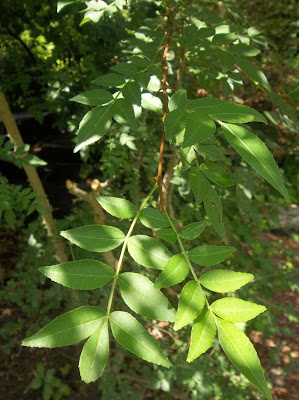
Zanthoxylum planispinum
Also called Zanthoxylum alatum. A large, deciduous open shrub to small tree, native to China, Korea and Japan, that reaches a maximum size of 20 x 15 ( rarely over 13 ) feet with a trunk diameter of 8 inches. The stems have spreading prickles up to 0.7 inches in length.
The pinnate leaves, up to 10 inches in length, are composed of 3 or 5 stem clasping, finely-toothed, oblong leaflets up to 6 x 1.3 inches in size. The foliage lasts very late in the fall up until Christmas. The attractive foliage is glossy mid-green. The winged leaf rachis is spined underneath.
The very small, pale yellow flowers are borne in small clusters in spring.
They are followed by very small, warty, red berries, up to 0.2 inches across.
Hardy zones 6 to 7.
Zanthoxylum schinifolium ( Korean Peppertree )
A spiny, deciduous small tree that is native to China and Korea. Largest on record - 25 x 28 feet.
The pinnate foliage is up to 7 inches in length and is composed of up to 21 elliptical leaflets up to 1.5 inches in length. The foliage is luxuriant mid green.
Hardy zones 5 to 9 in full sun to partial shade.
Zanthoxylum simulans ( Flatspine Prickly Ash )
A spiny, spreading, moderate growing, large bushy, rounded shrub native to mountains of China that can become tree like with age. Some records include: fastest recorded growth rate - 5 feet ( rarely more than 2 feet ); largest on record - 28 x 31 feet with a trunk diameter of 1 foot. A very large tree of 23 x 31 feet grows at Morris Arboretum in Philadelphia, PA.
The deciduous, aromatic foliage up to 9 inches in length is composed of 7 to 11 sparsely toothed, ovate leaflets that are up to 2 x 1 inches in size. The foliage is glossy bright green with prickles beneath. The leaves turn to orange and burgundy in fall. The leafstalk is spined. A cultivar has been reported to have purplish young foliage.
The tiny yellow flowers are borne in clusters up to 2.5 inches across in May.
The flowers are followed by very attractive, small, orange-red rounded berries in late summer. The flowers are followed by very aromatic, round, warty fruits up to 0.25 inches across that are green and ripen to scarlet-red. The fruits eventually dry and split open to release shiny, black seeds.
The bark is gray with spiny protuberances and the stems carry triangular flattened spines.
Thrives in full sun or partial shade on almost any fertile soil from zones 5 to 10. It thrives in both eastern North America as well as being one of the few species that thrives in the Pacific Northwest.
Rarely bothered by pests or disease.
The only pruning needed is removing lower branches to train as tree and removing dead wood. Propagation is by seed in autumn or root cuttings in late winter.
* photos taken on October 17 2010 @ National Arboretum, D.C.

Read More..
Many have fine timber which is used for cabinet making. Most have handsome aromatic foliage. The fruits on many are dried and used for spices.
*** These trees are essential for diets of and survival of the Thoas, Giant and Spicebush Swallowtail Butterflies. ( http://en.wikipedia.org/wiki/Giant_swallowtail )
Most prefer full sun to partial shade on moist, fertile, well drained soil.
Pruning is rarely necessary except for pruning young trees to shape.
Propagation is from seed, rooted suckers and cuttings.
Zanthoxylum ailanthoides ( Ailanthus Zanthox )
A very fast growing, prickly, large deciduous tree native to Korea, China and Japan, that can reach up to 60 feet. Some records include: fastest recorded growth rate - 10 feet; 10 years - 33 x 30 feet; largest on record - 66 x 60 feet with a trunk diameter of 4 feet. Massive old trees are known to grow in Korea. The canopy is broadly spreading and dome shaped and the branches are gnarled. That combined with the extremely attractive tropical looking foliage makes this an excellent tree for the landscape though rare and difficult to find.
The large, pinnate leaves reach up to 40 inches in length and are composed of up to 23 oblong, pointed, finely serrated, opposite arranged leaflets that are up to 6 x 2 ( rarely 4 ) inches in size. The foliage is glossy bright to blue-green above and blue green beneath.
The small, green white flowers are borne in terminal panicles up to 6 inches wide in spring to summer. They are followed by small green fruits that enclose a black seed.
The bark is gray and green striped with black spined protuberances.
Hardy zones 7 to 10 on any fertile, moist, well drained soil in full sun or partial shade. Easy to transplant and also easy to grow. It requires long hot summers for the wood to ripen and is not hardy in most of the British Isles.
Zanthoxylum americanum ( Common Prickly Ash )
A fast growing, spiny stemmed, handsome, small tree to 20 feet, native to eastern North America. Some records include: fastest recorded growth rate - 3 feet; largest on record - 40 x 30 feet with a trunk diameter of 1 foot. Rarely lives as much as 40 years though this tree often forms thickets with much longer living rootstock.
The Common Pricly Ash is native to North America ( from North Dakota to southern Quebec; south to Oklahoma to western Maryland to Massachussetts ).
The aromatic, foliage is pinnate up to 12 inches in length and composed of up to 11 ( rarely 13 ) oval leaflets up to 3 x 1 ( rarely over 2.5 ) inches in size. The foliage is glossy deep green.
The tiny, yellow flowers are borne on axilliary clusters, up to 2 inches across, before the foliage during mid-spring.
They are followed by black berries, up to 0.2 inches in length.
The stout twigs are light brown and spiny.
The bark is silvery. The wood is 35 pounds per square foot.
Thrives in full sun or partial shade on almost any fertile soil from zones 3 to 8.
Rarely bothered by pests or disease.
The only pruning needed is removing lower branches to train as tree and removing dead wood. Propagation is by seed in autumn or root cuttings in late winter.
* photos taken on May 16 2010 @ Cylburn Arboretum, Baltimore, MD
* photo taken on August 3 2010 @ University of Guelph Arboretum, Ontario
Zanthoxylum capensis
A tree native to South Africa that reaches up to 50 feet in height. Its leaves reach up to 8 inches in length and are composed of up to 20 leaflets up to 2.5 inches in length. Hardy zones 9 +
Zanthoxylum clava-hercules ( Hercules Club )
A rapid growing, small rounded tree to 30 feet or more in height that is native ( though rare ) to the southern U.S. from Oklahoma to coastal Virginia and south.
Largest on record - 66 x 50 feet with a trunk diameter of 2.5 feet. A very large tree is known to grow in the Holly Springs Cemetary in Nocogdoches County, Texas. A tree far north of its natural range is known to grow in Norristown, PA.
The foliage is alternately arranged though the leaflets are opposite on the leaf stems. The very fragrant leaves are up to 8 or rarely even 16 inches in length and are composed of 7 to 19, very shiny leaflets up to 3 x 1 inches in size that are deep green above and paler below. The leaf stems are spiny and the foliage lasts very late into the fall.
The greenish male and female flowers are borne in terminal clusters up to 5 x 3 inches on separate trees. They are followed by brown, wrinkled capsules up to 0.8 inches that split open to release one black seed.
The bark is light gray and studded with short spines. The brown twigs are armed with spines up to 0.5 inches long.
Thrives in sun or partial shade on any fertile though preferably moist sandy soil. The Hercules Club Ash is hardy from zones 5 to 10 and is tolerant of floods and heat.
* photo of unknown internet source
* photo taken by W.D. Brush @ USDA-NRCS PLANTS Database
Zanthoxylum coriaceum ( Biscayne Prickly-Ash )
A rare tree to 20 feet or more that is native to southeast Florida and the Caribbean. Some records include: fastest recorded growth rate - 4 feet; tallest on record - 33 feet. The evergreen foliage is up to 8 inches in length and is composed of glossy, green leaflets up to 2.5 x 1 inch. The spines are reddish-brown and the bark is smooth and gray mottled. Hardy in the tropics only ( zones 10 + )
Zanthoxlum cubense ( Cuban Zanthox )
Native to Cuba and reaching up to 45 feet in height; this Prickly Ash is suitable for the tropics ( zone 10 + ) only.
Zanthoxylum dipetalum
An endangered Hawaiian native that reaches a maximum size of 50 x 50 feet with a trunk diameter of 1 foot. Its tropical looking foliage is composed of up to 7 leaflets up to 12 x 5 inches in size. Hardy only zones 10 + where there is no frost and rainfall is abundant.
Zanthoxylum fagara ( Lime Prickly Ash )
A moderate growing, small evergreen tree native to Mexico, southern Texas and southern Florida that can reach up to 40 feet. Some records include: fastest recorded growth rate - 3 feet; largest on record - 60 x 40 feet with a trunk diameter of 2 feet.
The Lime Pricly Ash is also excellent as a dense hedge rather than tree. It is valuable as a food source of the Giant Swallowtail Butterfly.
The foliage is alternately arranged though the leaflets are opposite on the leaf stems. The leaves are up to 4 inches in length and are composed of 7 to 9, very shiny, bright green leaflets up to 1.2 x 0.5 inches in size. The leaf stems are winged.
The yellow-green male and female flowers are borne in axilliary clusters on separate trees. They are followed by brown, warty capsules that contain one black seed.
The bark is thin, gray and warty. The brownish twigs are spiny.
Thrives in sun or partial shade on any fertile soil. The Lime Prickly Ash is hardy from zones 8 to 11 and is very heat, salt and drought tolerant.
Zanthoxylum flavum ( Satinwood )
An evergreen, small tree to 30 x 35 feet or rarely more that is native to south Florida, the Caribbean and Bahamas. It was once common in southern Florida but is now endangered due to environmental destruction. The largest on record is 66 x 75 feet with a trunk diameter of 31 inches. It makes an excellent shade tree.
The foliage is alternately arranged though the leaflets are opposite on the leaf stems. The leaves are up to 10 inches in length and are composed of 5 to 11, leathery, shiny, smooth margined, elliptical, leaflets up to 3 x 1.5 inches in size that are deep green above and paler below. The leaf stems are spiny and the foliage lasts very late into the fall.
The greenish male and female flowers are borne in terminal clusters up to 5 x 3 inches on separate trees. They are followed by brown, wrinkled capsules up to 0.8 inches that split open to release one black seed.
The bark is light brown and smooth. The brown twigs have NO spines.
Thrives in sun or partial shade on any fertile though preferably moist sandy soil. The Satinwood is only hardy in the tropics from zone 10 and up. It is moderately salt tolerant.
Zanthoxylum gilletti ( African Satinwood )
Native to the mountains of Zimbabwe in Africa and reaches up to 100 feet. Should be planted only in zone 10 at high elevations ( ex. mounatins in Mexico and central South America )
Zanthoxylum hawaiensis
An endangered tropical small tree native to Hawaii. The largest on record is only 26 x 26 feet with a trunk diameter of 1 foot.
Zanthoxylum hirsutum ( Texas Prickly Ash )
Closely related to Zanthoxylum clava-hercules and similar in many ways. It is native to central Texas and is exceptionally tolerant of drought. It is also smaller typically less than 20 x 20 feet with a trunk diameter under 6 inches though sometimes much larger with the record being 51 x 30 feet with a trunk diameter of 1.5 feet. The leaves are up to 5 inches in length and are composed of leaflets up to 2 inches long.
Zanthoxylum martinicensis
A fast growing tree native to the Puerto Rico and the Caribbean reaching a height of 66 feet or rarely much more to 90 feet with a trunk diameter of 2.5 feet.
The leaves are composed of up to 19 leaflets up to 5 inches in length.
Hardy zones 10 and warmer only.
Zanthoxylum mayo
A large tree reaching a maximum height of 100 feet with a trunk diameter of 6.6 feet, that is native to the Juan Ferdinez Islands in Chile. The leaves are up to 7 inches in length and are composed of up to 18 leaflets that are up to 2 inches in length. Hardiness unknown but certainly restricted to mild maritime climates.
Zanthoxylum nova zelandiae
An old name for what is correctly now known as Hedycarya arborea.
Native to New Zealand and only grows in mild maritime climates. Largest on record - 40 feet in height with a trunk diameter of 2 feet.
Zanthoxylum piperitum ( Japanese Pepper )
A very beautiful, spiny, dense, bushy, rounded small tree native to mountains of China, Korea and Japan that grows moderately fast and reaches around 18 x 20 feet. Some records include: fastest recorded growth rate - 5 feet; largest on record - 33 x 25 feet.
The foliage is very aromatic and smells like Green Peppers. The pinnate leaves are up to 7 inches in length and are composed of 13 to 23 glossy, lustrous, very deep green, oval leaflets up to 1.5 x 1 or rarely 2.5 x 1.5 inches in size.
The small, yellow-green flowers are borne in clusters up to 6 inches across in spring. The flowers are followed by tiny, orange berries.
The bark is beige to red-brown.
Thrives in full sun or partial shade on almost any fertile soil from zones 5 to 7.
Rarely bothered by pests or disease.
The only pruning needed is removing lower branches to train as tree and removing dead wood. Propagation is by seed in autumn or root cuttings in late winter.
* photos taken on May 16 2010 @ Cylburn Arboretum, Baltimore, MD
* photos taken on October 17 2010 @ National Arboretum, D.C.
* photos taken on June 23 2013 @ U.S. National Arboretum, DC
Zanthoxylum planispinum
Also called Zanthoxylum alatum. A large, deciduous open shrub to small tree, native to China, Korea and Japan, that reaches a maximum size of 20 x 15 ( rarely over 13 ) feet with a trunk diameter of 8 inches. The stems have spreading prickles up to 0.7 inches in length.
The pinnate leaves, up to 10 inches in length, are composed of 3 or 5 stem clasping, finely-toothed, oblong leaflets up to 6 x 1.3 inches in size. The foliage lasts very late in the fall up until Christmas. The attractive foliage is glossy mid-green. The winged leaf rachis is spined underneath.
The very small, pale yellow flowers are borne in small clusters in spring.
They are followed by very small, warty, red berries, up to 0.2 inches across.
Hardy zones 6 to 7.
Zanthoxylum schinifolium ( Korean Peppertree )
A spiny, deciduous small tree that is native to China and Korea. Largest on record - 25 x 28 feet.
The pinnate foliage is up to 7 inches in length and is composed of up to 21 elliptical leaflets up to 1.5 inches in length. The foliage is luxuriant mid green.
Hardy zones 5 to 9 in full sun to partial shade.
Zanthoxylum simulans ( Flatspine Prickly Ash )
A spiny, spreading, moderate growing, large bushy, rounded shrub native to mountains of China that can become tree like with age. Some records include: fastest recorded growth rate - 5 feet ( rarely more than 2 feet ); largest on record - 28 x 31 feet with a trunk diameter of 1 foot. A very large tree of 23 x 31 feet grows at Morris Arboretum in Philadelphia, PA.
The deciduous, aromatic foliage up to 9 inches in length is composed of 7 to 11 sparsely toothed, ovate leaflets that are up to 2 x 1 inches in size. The foliage is glossy bright green with prickles beneath. The leaves turn to orange and burgundy in fall. The leafstalk is spined. A cultivar has been reported to have purplish young foliage.
The tiny yellow flowers are borne in clusters up to 2.5 inches across in May.
The flowers are followed by very attractive, small, orange-red rounded berries in late summer. The flowers are followed by very aromatic, round, warty fruits up to 0.25 inches across that are green and ripen to scarlet-red. The fruits eventually dry and split open to release shiny, black seeds.
The bark is gray with spiny protuberances and the stems carry triangular flattened spines.
Thrives in full sun or partial shade on almost any fertile soil from zones 5 to 10. It thrives in both eastern North America as well as being one of the few species that thrives in the Pacific Northwest.
Rarely bothered by pests or disease.
The only pruning needed is removing lower branches to train as tree and removing dead wood. Propagation is by seed in autumn or root cuttings in late winter.
* photos taken on October 17 2010 @ National Arboretum, D.C.
Subscribe to:
Posts (Atom)